
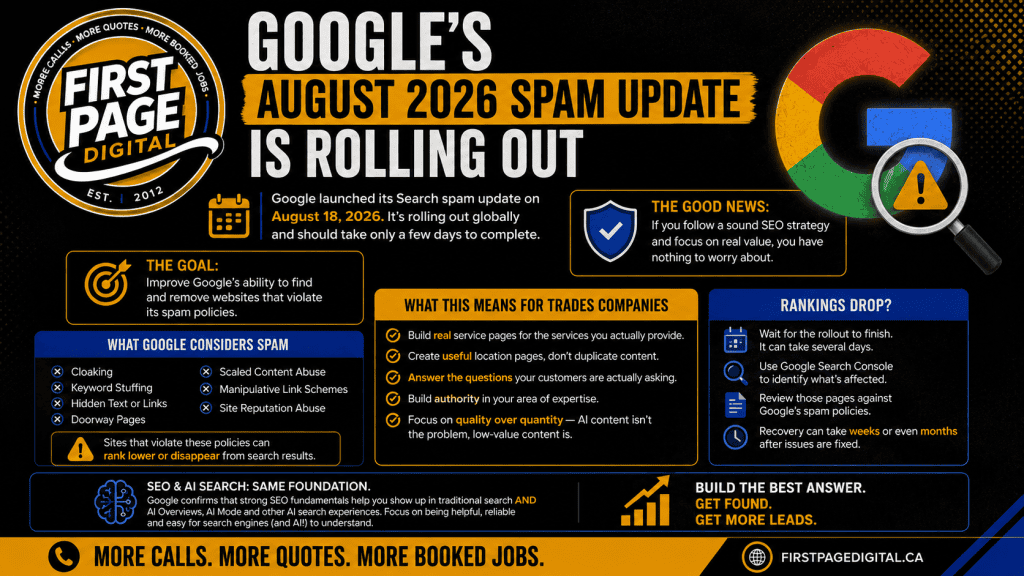

Google started rolling out its August 2026 spam update on August 18. If your phone has gone quieter this week, or you’ve noticed fewer form fills and quote requests, you’re probably wondering whether Google is the reason.
Here’s the useful part most coverage skips: this update almost certainly can’t hurt a trades website through backlinks. Google has indicated this rollout doesn’t specifically target link spam or its site reputation abuse policy. That matters, because it narrows the list of things that could have hit you down to one category — what’s actually on your own pages. And on-page problems are the ones trades sites are most likely to have without realizing it.
This post walks you through what the update is, the specific on-page issues that put home-service sites at risk, and exactly how to check your own site in Google Search Console before you change a single thing.
First, don’t touch anything yet
Every algorithm update triggers the same reflex: rankings wobble, panic sets in, and someone starts deleting pages on day two. Resist it.
The rollout takes several days to finish, and rankings genuinely bounce around while Google recalculates. For reference, the March 2026 spam update completed in under a day, while June took about two. A single day’s data tells you almost nothing. Reacting to noise mid-rollout is how people break pages that were fine.
Wait for the rollout to be confirmed complete, then diagnose. Which brings us to the part that actually matters.
What “spam” means when Google says it — for a plumber, not a spammer
The word “spam” makes most trades owners tune out, because they picture pill emails and hacked casino links. Google’s definition is broader and quieter than that, and several of its categories describe things ordinary, well-meaning home-service sites do every day — usually because an old web designer or a cheap SEO package set it up that way.
Here are the ones that actually bite trades sites:
Duplicate “city” pages. This is the single most common issue we see on trades websites. You offer furnace repair, so someone built you 30 location pages — Furnace Repair in Barrie, Furnace Repair in Orillia, Furnace Repair in Innisfil — each with the same 500 words and the town name swapped in. Google calls this doorway abuse and scaled content abuse. It was risky before; updates like this one are exactly when it catches up with you.
Thin service pages. A single paragraph per service, or a services page that lists ten trades with two sentences each. It’s not deceptive, but Google reads it as a page that doesn’t deserve to rank over a competitor who actually explained the work, the pricing, and the process.
Pages for areas you don’t really serve. Listing 40 towns to “cover the whole region” when you realistically work in six. Google’s systems are increasingly good at spotting service-area pages with no genuine local substance behind them.
AI-generated blog dumps. Publishing dozens of generic articles because a keyword tool showed volume — “10 Signs You Need a New Roof” with no local angle, no expertise, no reason it came from you specifically. Using AI to help write is fine. Using it to manufacture volume is the exact behavior Google’s scaled content policy targets.
Keyword-stuffed footers and hidden text. Older trades sites often have a footer crammed with every city-plus-service combination, or (on genuinely old builds) blocks of light-grey keywords hidden against a white background. If that’s on your site, it’s a liability.
None of these require bad intent. Most trades owners inherited them. But this update is precisely the kind that reprices pages built this way — and because backlinks are off the table this round, if you got hit, the cause is very likely sitting in one of the buckets above.
How to actually check your site in Google Search Console
Once the rollout is confirmed complete, here’s the diagnostic. It takes about fifteen minutes and it’s the same process we run for clients.
1. Open the Performance report. In Google Search Console, go to Performance → Search results. Make sure both Clicks and Impressions are toggled on. Clicks tell you about traffic; impressions tell you about rankings. A drop in impressions means you’re showing up for fewer searches — that’s the ranking signal you care about.
2. Compare the right dates — and this is where trades sites get it wrong. Your business is seasonal. Furnace and heating searches fall off a cliff in spring no matter what Google does; AC and cooling do the opposite. If you compare this week to last month, you’ll mistake normal seasonality for a penalty and start “fixing” a site that’s fine.
Use a year-over-year comparison instead. Set the date range to the two weeks after August 18, then compare against the same two weeks last August. That controls for season and isolates whether this update moved you, rather than the calendar.
3. Find out where the drop lives. A real spam-update hit is rarely uniform. Use the Pages tab to see whether the decline is site-wide or clustered. If your /locations/ or city pages all dropped together while your homepage and main service pages held, that’s a strong signal — it points straight at the duplicate-city-page problem above. Then check the Queries tab: did you lose a specific type of search, or everything?
4. Read the pattern. Clustered drop on thin or duplicated pages → on-page quality is your suspect. Broad, even, gentle drift across everything → more likely normal fluctuation or unrelated. The shape of the drop tells you where to look.
Before you rush to fix it: understand the recovery clock
This is the part that should change how you think about the whole thing.
Google is clear that recovery from a spam-related decline is not immediate. Even after you’ve genuinely fixed the problem, its automated systems can take months to re-evaluate your site and restore rankings — because it needs to see sustained compliance, not a one-time cleanup.
Read that again, because it flips the economics. If a bad city-page setup costs you three or four months of leads to recover from, then the cheap fix isn’t fixing it after you’re hit — it’s not having the problem when the next update lands. And there’s always a next update: this is Google’s third spam update of 2026 alone.
For a trades business, three months of suppressed rankings during your busy season isn’t a ranking problem. It’s a revenue problem. [If you have it: “When we took on [client type], we found X duplicate location pages suppressing their whole domain — here’s what happened after we consolidated them.” Drop a real example here. It’s the most persuasive thing on the page and nobody else can copy it.]
The strategy underneath all of this
Strip away the update and the takeaway for a trades company is the same as it’s always been, just with sharper stakes: you don’t need to trick Google, and the shortcuts are now actively expensive.
One furnace-repair page that genuinely explains the job, the common causes, what a repair costs in your area, and why someone should trust your team will outperform thirty near-identical city pages — and it won’t get you flagged. The same fundamentals now feed AI Overviews and AI Mode, too; Google has confirmed there’s no separate playbook for showing up in AI search. Build the page that deserves to rank, and you’re covered on both fronts.
That’s not an SEO trick. It’s just being the best answer to what your customer typed.
Worried you got hit? Let’s look at your actual data.
If your leads dropped this week and you’re not sure whether it’s the update, seasonality, or something on your site, we’ll tell you — for free.
At First Page Digital, we do SEO and AI search visibility specifically for trades and home-service companies. We’ll run the Search Console diagnostic above on your site, identify whether any of the on-page issues here apply to you, and give you a straight answer on where you stand — no obligation.
Book your free trades-site diagnostic →
More calls. More quotes. More booked jobs — from a site built to hold up to the next update, not just this one.
Sources: Google’s Search Status Dashboard and spam-update documentation; Search Engine Roundtable and Search Engine Journal reporting on the August 2026 spam update (August 18, 2026).