
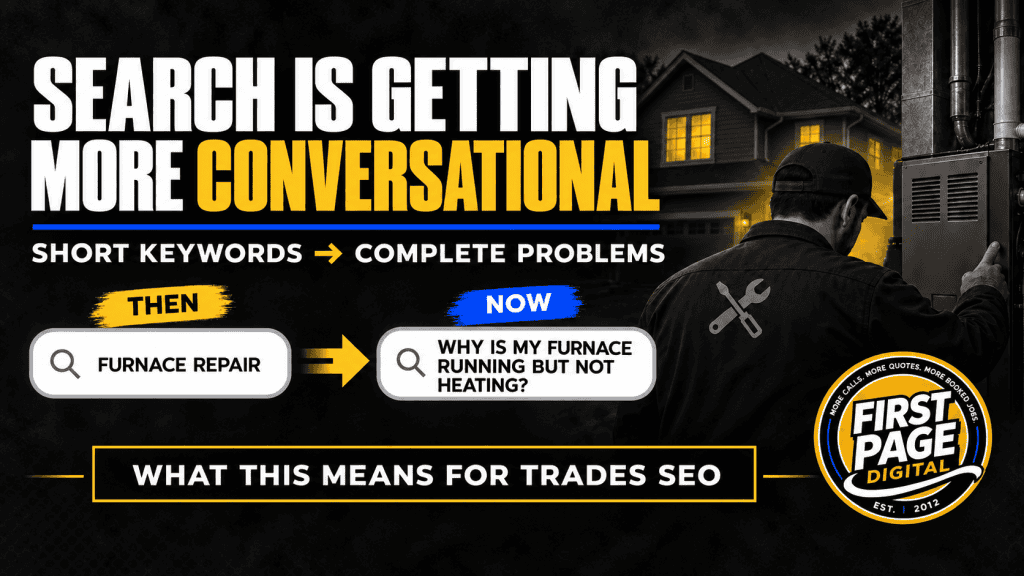

Five years ago, someone with a broken furnace typed “furnace repair” into Google. Now they type “why is my furnace running but not heating the house.”
That sounds like a small change. It isn’t. It changes what your website has to say to get the call.
The numbers
A September 2026 analysis of Google Ads search data (here) tracked how long people’s searches were from January 2025 to August 2026.
- One-and-two-word searches dropped from 42% of impressions to 24%.
- Three-and-four-word searches rose from 33% to 48%.
- The share of conversions from three-and-four-word searches went from 20% to 46%.
That last one is the one that matters to you. The longer searches aren’t just more common. They’re the ones turning into customers.
One honest caveat: this is one advertiser’s data, not a Google-wide number, and it can’t prove AI Mode caused it. But it lines up with what I see in my clients’ Search Console accounts, and it’s the direction everything is moving.
Why it’s happening
Google got good at understanding plain language, and AI answers taught people they don’t have to speak in keywords anymore. So a homeowner types the way they’d talk to a neighbour.
Instead of “HVAC contractor Orillia,” it’s “why does my furnace keep shutting off before the house warms up.”
The first search tells you they want an HVAC company in Orillia. The second tells you what’s wrong, that it’s happening now, and that they’re worried enough to look it up. That’s a better lead, if your website is built to catch it.
What this means for your site
The “professional, reliable, affordable” page is dead weight
Most contractor service pages say some version of “we provide professional, reliable and affordable furnace repair.” So do the other four hundred furnace pages in Ontario. Google can’t tell them apart and neither can the homeowner.
A furnace repair page that catches full-sentence searches covers what an experienced tech would tell someone on the phone:
- The common reasons a furnace runs but doesn’t heat
- Which symptoms mean “call today” and which can wait until Monday
- What a diagnostic visit involves and roughly what affects the price (the same reason I publish my own pricing: people trust a number more than a “call for a quote”)
- When it’s worth repairing a 15-year-old unit and when it isn’t
- Which towns you’ll come out to, and whether you do emergency calls
That’s not stuffing questions into a page. It’s the page finally saying something useful.
People search the symptom, not the service
A homeowner with one cold bedroom doesn’t search “duct balancing.” They search “why is one room colder than the rest of the house.” They don’t know if that’s a furnace problem, a duct problem, or a filter. That’s your job.
If your site only uses the formal service names, you miss those people. The fix is content that connects the symptom to the service in plain language, without diagnosing over the internet. “Here are the four usual causes; here’s which ones you can check yourself; here’s when to call.”
Longer searches tell you how urgent it is
“Roofing company” and “emergency roof leak repair Barrie after storm” are both roofing searches. One is someone thinking about it. The other is someone standing under a drip with a bucket.
Your page should treat them differently. The emergency searcher needs a phone number at the top and “we answer 24/7” in the first line. The researcher needs a cost guide and a quote button. Same trade, different page, different call to action.
What you should NOT do
This is where a lot of contractors, and a lot of agencies, get it wrong.
You don’t need a page for every question. “Why is my furnace blowing cold air,” “furnace running but air is cold,” and “cold air from furnace vents” are the same question. One good furnace repair page, or one strong supporting article, covers all of them. Fifty thin pages that each answer one phrasing is how you get a bloated site Google ignores.
Also avoid:
- Copying awkward long-tail phrases word for word into headings
- A 30-question FAQ section full of two-sentence generic answers
- AI-written articles with no actual trade knowledge in them
- Replacing clear service information with vague chatty copy
- Measuring any of this by rankings instead of calls
The goal is not to make your site sound like a chatbot. It’s to make it sound like your best tech explaining the problem to a customer.
The short searches still matter, and here’s where
“Electrician near me,” “roofer Orillia,” “furnace repair Barrie” are still the searches that put you on the Google map, and the map is still where most local calls come from. Your Google Business Profile, your service pages, your town pages, your categories: all of that still does the heavy lifting.
The longer searches mostly land in the regular results and the AI answers underneath the map. They’re the second layer. What’s changed is that the second layer is now where a lot of the buying decisions get made, and a page that only says “Barrie furnace repair” six times doesn’t win there.
What to actually do
- Open Search Console and read the queries. Ignore the top ten by volume. Look for searches that mention a symptom, a brand, urgency, a price, a town, or “repair vs. replace.” Group them by what the person actually wants. That list is your content plan.
- Fix your main service pages before writing another blog post. For each one, check: does it say who it’s for, what problems you handle, what the process is, when to call, what affects the price, where you serve, and what to do next? If not, that’s the work.
- Write down what customers ask on the phone. “Can you come today?” “Is it safe to keep running?” “Do you service Lennox?” “What do you need from me before you come out?” Those questions, answered by someone who’s done the job, beat anything a keyword tool suggests. If you’re not sure which ones are worth a page, send me your list and I’ll tell you.
- Match the button to the search. Emergency pages get a phone number. Cost pages get a quote form. Comparison pages get “book an inspection.”
If you run Google Ads, do one more thing: pull the search terms report and compare short searches to long ones on cost per lead. In most trades accounts I’ve looked at, the long ones are cheaper and close better.
The bottom line
People are telling Google more about what they need. That’s an opportunity to win on expertise instead of on repeating a keyword more times than the guy down the road.
Fewer, stronger pages. Real answers from real experience. Clear next step. And the map still comes first.
If your site ranks for the broad terms but isn’t catching the specific searches people use when they’re ready to hire, that’s usually a service-page problem, not a “need more blog posts” problem. Here’s how the SEO work for trades companies is structured, or send me your site and I’ll tell you what I see.
First Page Digital does SEO for trades and home-service businesses across Simcoe County and Muskoka. We report calls and jobs, not traffic. (705) 259-3656 | firstpagedigital.ca