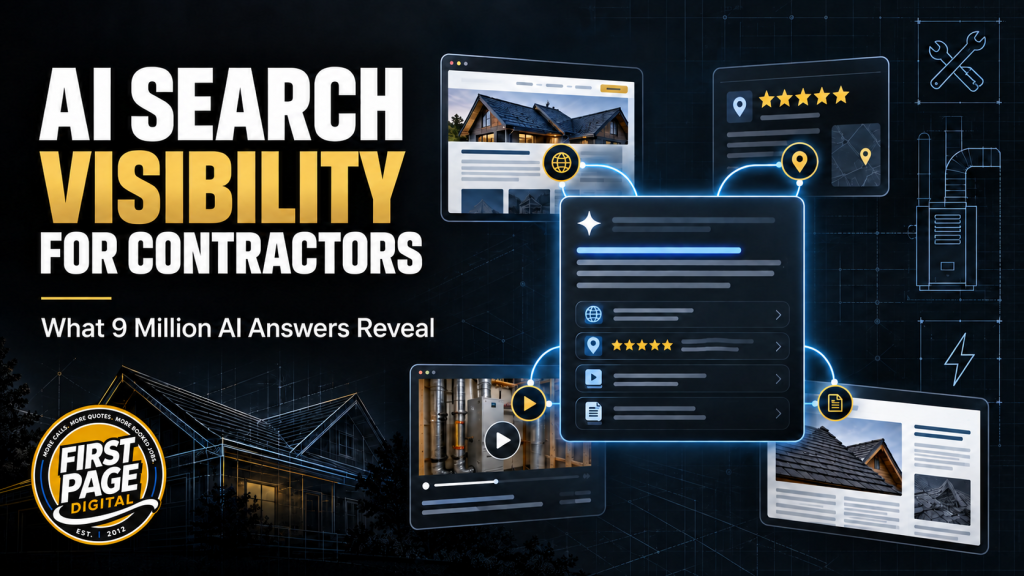

To show up in AI-generated answers (Google AI Overviews, ChatGPT, Gemini and others), a trades business needs two things working together. First, genuinely helpful, specific content on its own website, detailed service pages and documented real projects that answer the questions customers actually ask. Second, a credible footprint beyond the website: strong Google reviews, legitimate directories and associations, useful video, and consistent business information everywhere it appears. AI platforms build their answers from both your site and what independent sources say about you. The businesses that win are the ones that are the clearest, most credible and best-supported answer available, not the ones using the most tricks.
Here’s what’s changing and what to actually do about it.
Google AI Overviews, AI Mode, ChatGPT and other AI-powered platforms are changing how customers research local contractors.
Instead of searching only for short phrases such as “roofer near me,” homeowners can now ask detailed questions:
- Who is the best roofing contractor in Barrie for a metal roof?
- How much should it cost to replace a furnace in Ontario?
- Which local electrician has experience upgrading older electrical panels?
- Is this plumbing company reputable?
- What should I look for when comparing HVAC quotes?
These platforms then combine information from business websites, directories, videos, reviews and independent publications to produce a single response.
That means ranking your website remains important, but it may no longer be enough on its own.
What a Study of Nine Million AI Answers Found
An NP Digital analysis titled “AI Visibility at Scale: Learning From 9M Prompts and 400+ Enterprise Brands,” led by Nikki Lam, examined approximately nine million AI-generated answers across nine platforms, including ChatGPT, Google AI Overviews, AI Mode, Gemini, Perplexity, Copilot, Claude, Grok and Meta AI.
The dataset covered more than 400 enterprise brands, so the findings should not be treated as a perfect representation of every local contractor. However, the results provide useful clues about how AI platforms select and retain sources.
Three findings are particularly relevant to trades businesses.
1. Ordinary web pages earn most AI citations
Approximately 64% of the citations in the study came from ordinary webpages, not content created in a special “AI-friendly” format.
This is an important reality check. A contractor does not necessarily need to produce dozens of artificial listicles, repetitive FAQ pages or articles written exclusively for AI engines. A detailed service page, project page or practical guide can earn citations when it provides the clearest answer to a customer’s question.
For example, an HVAC company’s furnace-replacement page (the kind of service page built to rank we focus on) becomes more useful when it explains:
- Typical factors affecting replacement cost
- Differences between common furnace types
- When repair may be more economical than replacement
- How the home’s size and ductwork affect the recommendation
- Available rebates or financing options (for more on pricing content, see our guide on how much SEO costs for trades companies)
- What the installation process involves
- The areas the company serves
- Real examples from completed projects
The objective is not to make the page longer for the sake of word count. It is to make it more complete, specific and helpful.
2. Third-party sources dominate commercial questions
The analysis found that 82% of citations attached to commercial-intent prompts went to third-party sources, while only 3% went directly to the brands’ own websites. Although the dataset focused on enterprise brands rather than local contractors, it suggests that AI platforms frequently seek independent corroboration when answering purchase-oriented questions.
Commercial-intent questions are searches that indicate someone may be close to hiring or purchasing. For trades businesses, these could include:
- Best roofing companies in Barrie
- Top-rated HVAC contractor in Orillia
- Who should I hire to replace my electrical panel?
- Is this contractor reliable?
- Best company for emergency plumbing near me
When people ask these questions, AI systems frequently look beyond the contractor’s own claims. They may consult Google reviews, industry associations, directories, local publications, videos, community discussions and comparison articles.
That makes sense. Every contractor can say they provide excellent service. Independent sources help an AI platform evaluate whether other people and organizations support that claim.
For trades businesses, AI visibility is therefore partly a reputation and digital-footprint challenge, not simply a website-content challenge.
3. Citations from your own website are still extremely valuable
Although company-owned pages earned a relatively small percentage of commercial citations, the study found that an owned citation was associated with a much larger improvement in overall AI visibility.
Owned citations also reportedly remained visible between three and nine times longer than citations from third-party sources, which frequently changed or disappeared.
This creates an important distinction: third-party coverage can help an AI platform trust or recommend a business, but strong first-party content gives the business a more durable source of information.
Contractors should therefore avoid choosing between website content and external reputation building. The strongest strategy requires both.
What This Means for Contractors
Build better service pages before creating more pages
Many contractor websites contain several pages that say essentially the same thing with a different service or city inserted into the heading. That may create more URLs, but it does not necessarily create more useful information.
A better service page (something we build as part of SEO for trades and web design for trades) should answer the questions a homeowner would normally ask during the first phone call. It should explain the problem, available solutions, relevant costs, warning signs, timelines and what makes the company’s approach different.
Include original details wherever possible:
- Photographs from real jobs
- Before-and-after examples
- Typical project timelines
- Explanations from qualified technicians
- Service limitations
- Warranty information
- Local permitting considerations
- Specific examples from the communities served
These details give search engines and AI platforms information that cannot be copied from hundreds of similar contractor websites.
Turn completed projects into evidence
A completed job can produce more than a social media post. A strong project profile can document:
- The customer’s original problem
- The inspection or diagnostic process
- The recommended solution
- Products and materials used
- Challenges encountered
- The final result
- Photographs or video
- The city or service area
- A customer testimonial, with permission
This type of first-hand evidence helps establish genuine experience. It can also support service pages, social posts, videos, proposals and future AI-generated answers. You can see this approach in our own client case studies, including Severn Roofing, Simcoe Muskoka Home Comfort and Ducts on the Run.
For example, “We install heat pumps” is a basic service claim. A documented case study showing how a heat pump performed in a particular Ontario home is much harder to imitate, and much more useful to a homeowner. (See how we did this for an HVAC client.)
Strengthen your presence beyond your website
Because third-party sources influence commercial AI answers, contractors should pay attention to the information published about them elsewhere. That includes:
- Google Business Profile reviews
- Relevant trade and professional associations
- Manufacturer or dealer directories
- Local chambers of commerce
- Trusted local directories
- Community publications
- Supplier or partner websites
- Legitimate awards and certifications
- Local sponsorships and community involvement
Consistency matters. Your business name, service areas, contact details, qualifications and core services should agree across these sources.
The goal is not to manufacture mentions or place the company on every directory available. It is to build a credible footprint on sources that real customers, and AI systems, have a reason to trust.
Add useful video content
YouTube was one of the strongest third-party sources identified in the study. This creates a practical opportunity for trades businesses, because many contractor questions are visual.
A roofer can explain how to identify damaged shingles. An HVAC technician can demonstrate why a furnace is short-cycling. An electrician can explain what happens during a panel upgrade. A plumber can show homeowners how to locate their main shutoff valve.
These videos do not require elaborate production. They require a knowledgeable person, clear audio and a genuinely useful explanation. Each video can support a relevant service page, be repurposed for social media and provide another source that AI platforms may use when answering customer questions.
Do not chase AI citations at the expense of customers
AI search has created a new round of marketing shortcuts: mass-produced articles, fake comparison pages, automated directory submissions and content written primarily to manipulate citations. These tactics may produce temporary visibility, but they do not create the trust required to win a job.
The fundamentals remain familiar:
- Answer real customer questions
- Demonstrate first-hand experience
- Publish accurate information
- Earn legitimate reviews and mentions
- Make qualifications easy to verify
- Provide a clear next step for customers
The difference is that these signals now influence more than conventional Google rankings. They can also affect how AI platforms describe, cite and recommend a business.
How Should AI Visibility Be Measured?
A citation is encouraging, but it is not automatically a lead. Some AI systems may use a webpage as a source without prominently naming the company. Customers may also see the brand in an answer without clicking through to the website.
First Page Digital recommends evaluating AI visibility across several layers:
- Appearances: Is the business appearing in relevant AI-generated answers?
- Citations: Is the website included as a source?
- Brand mentions: Is the company actually named in the answer?
- Sentiment and context: How is the business being described?
- Referral traffic: Are AI platforms sending visitors to the website?
- Conversions: Are those visitors calling, submitting forms or requesting quotes?
This prevents an impressive-looking citation count from being mistaken for actual marketing performance.
The Practical Takeaway
AI search does not eliminate the need for SEO. It expands the number of places where a contractor’s expertise and reputation may be evaluated.
The most durable approach is to build a connected body of evidence:
- Helpful service pages
- Detailed project examples
- Accurate local-business information
- Strong customer reviews
- Credible third-party mentions
- Useful videos
- Clear qualifications and service coverage
For trades businesses, becoming visible in AI-generated answers is not about discovering one technical trick. It is about becoming one of the clearest, most credible and best-supported answers available.
First Page Digital helps Ontario contractors improve their visibility across traditional Google results, local search and emerging AI-powered experiences. If you want to understand how your business currently appears, or where competitors have the advantage, contact us for a digital visibility assessment, or see how we get trades companies found.
Note: The research discussed in this article is a proprietary NP Digital analysis of enterprise brands across multiple AI platforms, not an independent study of local trades businesses. Its findings are directional and should not be treated as universal benchmarks for contractors. Source: “AI Visibility at Scale: Learning From 9M Prompts and 400+ Enterprise Brands,” NP Digital (Nikki Lam), neilpatel.com/blog/ai-visibility-myths-data.